Her cardiologist said “we will monitor it” , here’s what she isn’t telling you.
In a breed where nearly every dog develops a leaking valve, “monitor and wait” quietly translates to: watch your Cavalier get worse, and do nothing while it happens.


Dr. Sarah Whitfield, DVM, DACVIM
Board-Certified Veterinary Cardiologist • Nashville, TN
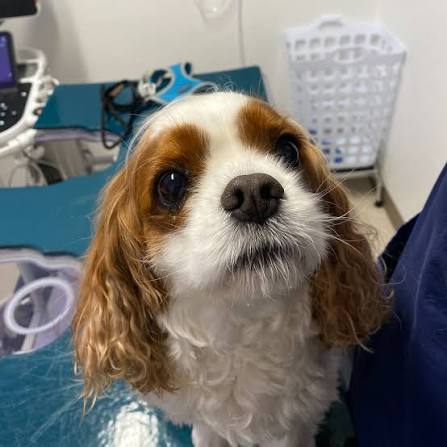
Every Cavalier owner I see in my exam room has been handed the same script. The cardiologist puts down the stethoscope, smiles gently, and says some version of: “She has a small murmur. It’s very common in the breed. We’ll monitor it and come back in six months.”
Owners leave that appointment relieved. They think they have caught something early. They have not. They have caught it on schedule, and the appointment they just had does almost nothing to change what happens next.
I am a board-certified veterinary cardiologist. I have spent twenty-two years looking at Cavalier hearts on echocardiogram. I own one myself. And I am going to tell you what the words “we’ll monitor it” actually mean, because almost nobody explains it honestly.
What “monitor and wait” really means
Mitral valve disease (MVD) in Cavaliers is not an event. It is a long, quiet structural failure. The leaflets of the mitral valve are made of connective tissue: collagen, elastin, glycosaminoglycans. In this breed, that tissue begins thickening and stiffening years before any vet hears a click through a stethoscope.
By the time you hear the words “Grade 1 murmur,” the valve has already been changing at the cellular level for a long time. What “monitoring” tracks is how fast that failure progresses. It does not slow it. It does not stop it. It does not feed the connective tissue that is breaking down. It just grades the deterioration on a scale of 1 to 6 and books another appointment in six months.
A cardiologist at a breeders’ symposium in Virginia put it more bluntly than I ever did: “We are screening these dogs at the point of no return and calling it early detection.”
“Annual checkups and waiting for a murmur is not early detection. It is late detection with a professional label on it.”
The gap nobody warns you about
When the murmur progresses, the standard cardiac protocol kicks in: a stack of prescription heart medications, diuretics, and blood pressure modulators. Three hundred dollars a month in pills, set to two daily alarms on your phone.
I prescribe these protocols every week. They save lives. They extend lives. They are not optional once the disease is advanced. But here is what almost no one explains to owners at the pharmacy counter:
None of these prescriptions support the valve itself. The heart medications make the muscle pump harder to compensate for the leak. The diuretics pull fluid off the lungs. The aldosterone blockers manage pressure. They manage the downstream consequences of valve failure. Not one of them provides anything to the connective tissue in the leaflets that is actively degenerating.
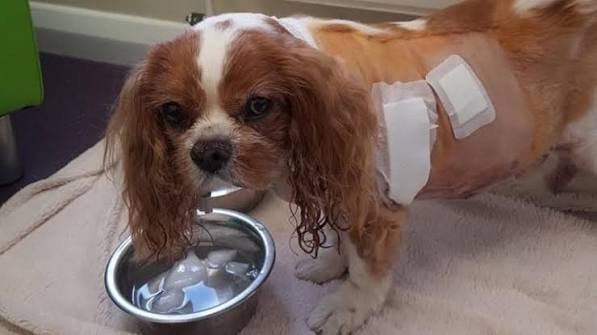
I call this the valve gap. It is the space between what owners think they are covering (“gold standard cardiac care”) and what is actually being addressed (the pump, not the valve). The leaflets keep thickening between echo appointments. B1 becomes B2. B2 becomes C. The grades climb and the pills multiply.
What the valve actually needs
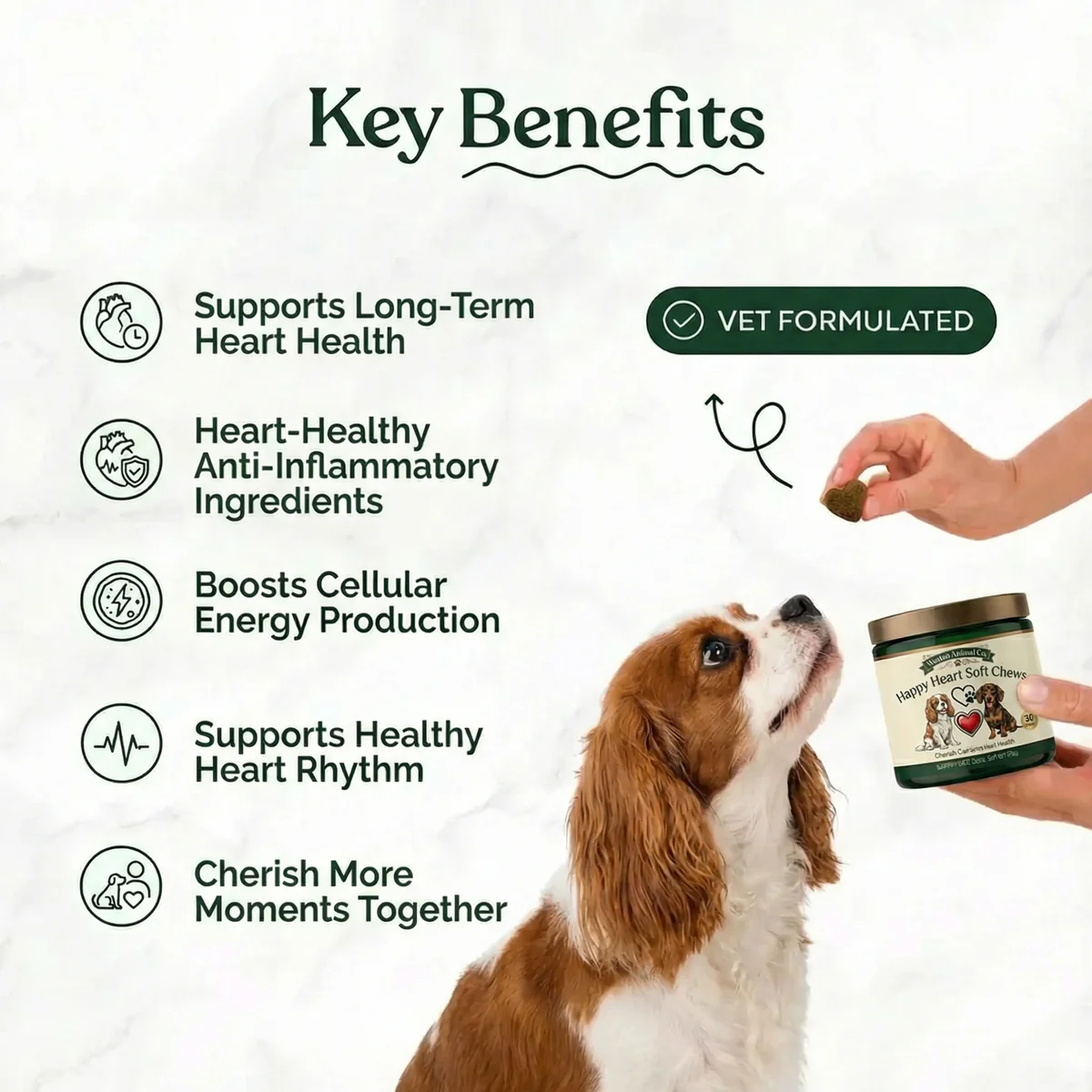
The mitral valve is connective tissue, and connective tissue needs raw materials to stay structured. Specifically: ubiquinol CoQ10 for cardiac cellular energy at the mitochondrial level, marine-source omega-3s with a defined EPA/DHA ratio for cardiovascular tissue, taurine for cardiac muscle function, and standardized hawthorn for coronary microcirculation.
These are not generic heart vitamins. They are specific compounds at therapeutic doses that target the connective-tissue matrix in cardiac valve structures. And critically, the form matters: ubiquinol, not the cheaper ubiquinone; marine-derived EPA/DHA, not flaxseed; standardized hawthorn extract, not whole-berry powder.
I started my own Cavalier, Eleanor, on this exact stack at fourteen months old. She is ten now. Her last echocardiogram was clean. In a breed where nearly 100% have a murmur by ten, that is not a result I can explain by genetics alone.
Why most “heart chews” on Amazon don’t work for Cavaliers
Before you go searching, read the label. The majority of canine heart supplements on the market are built around taurine and L-carnitine. Those address dilated cardiomyopathy , a different cardiac disease, common in Dobermans and Boxers. They are not formulated for valve degeneration.
For a Cavalier, the wrong formula is the same as no formula. The valve does not care that the bottle says “heart support” on the front. It cares whether the specific compounds it needs are present, in the right form, at the right dose, for a 14–18 lb dog.
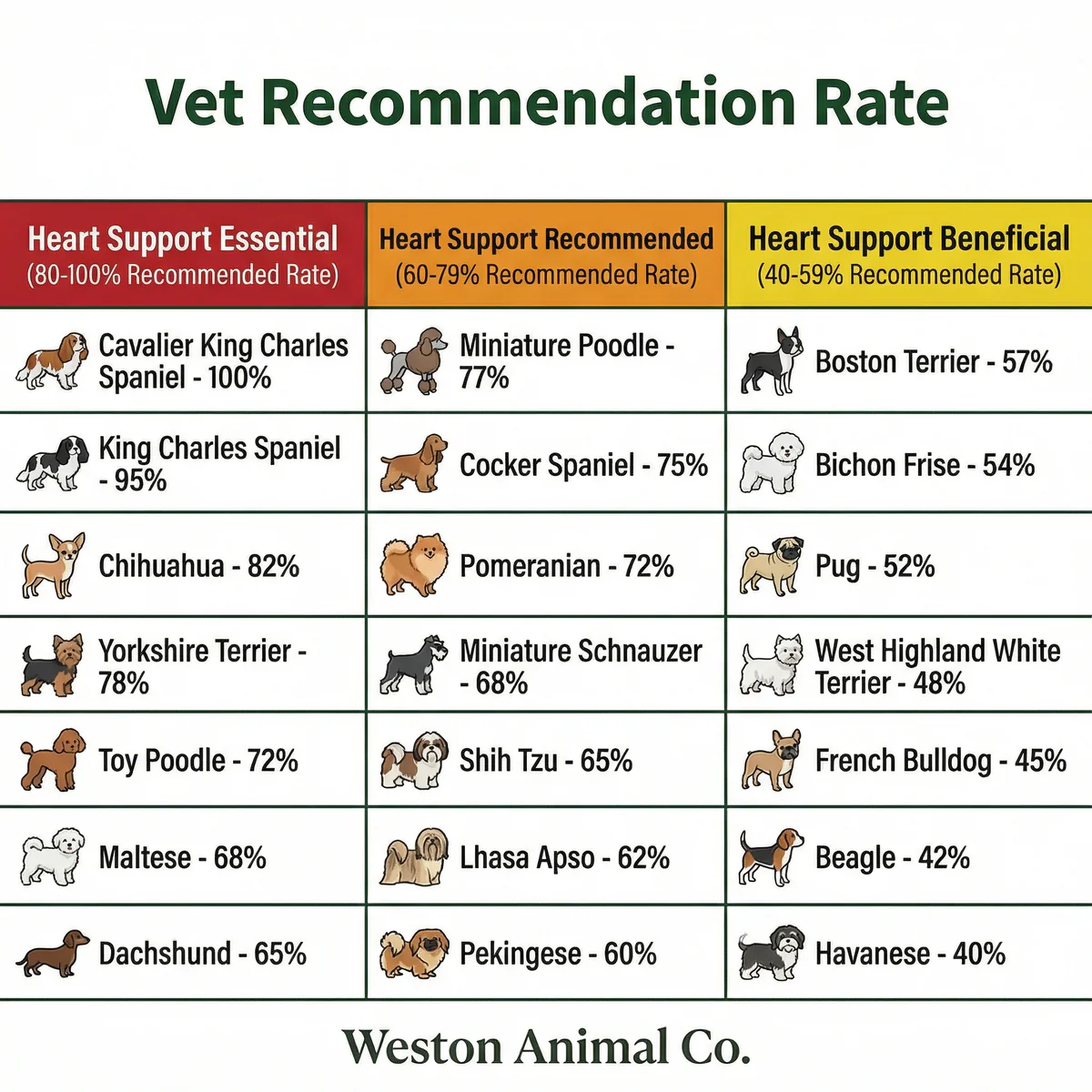
What I now recommend
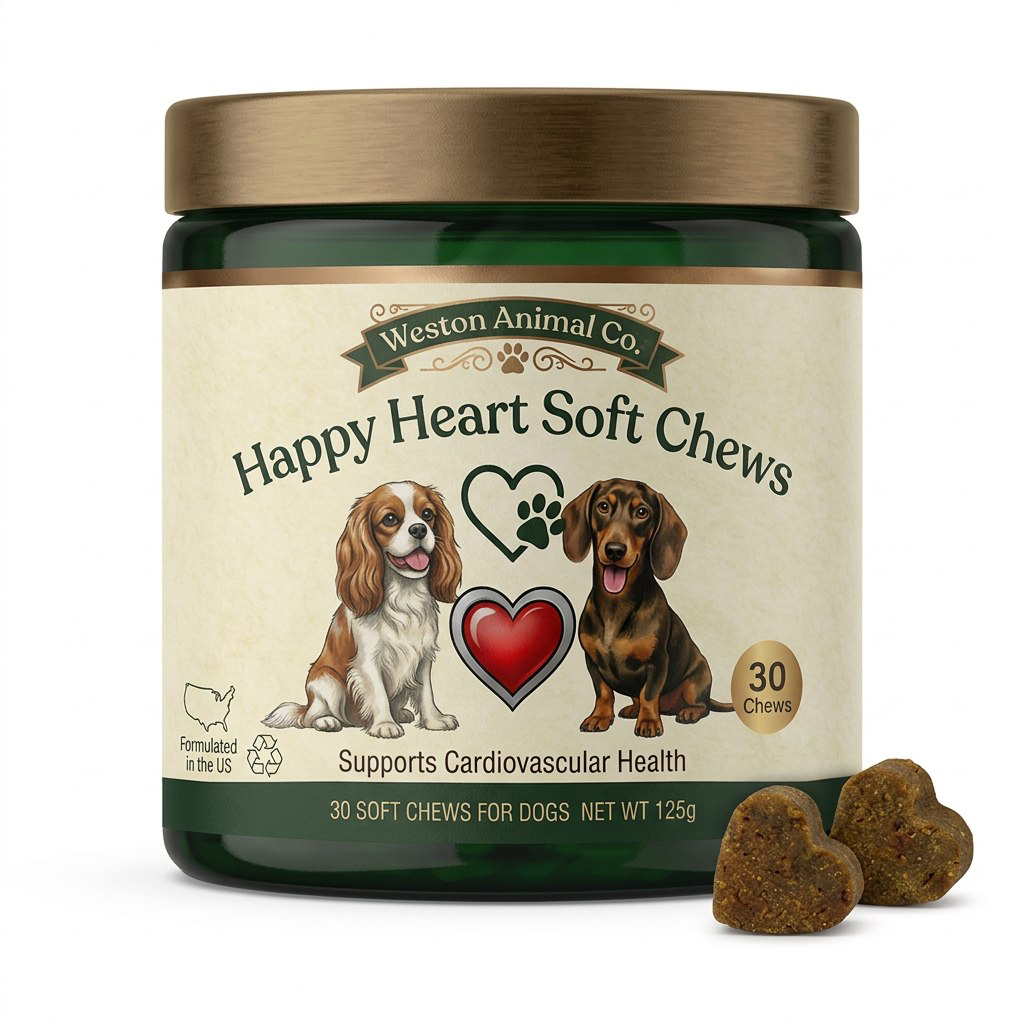
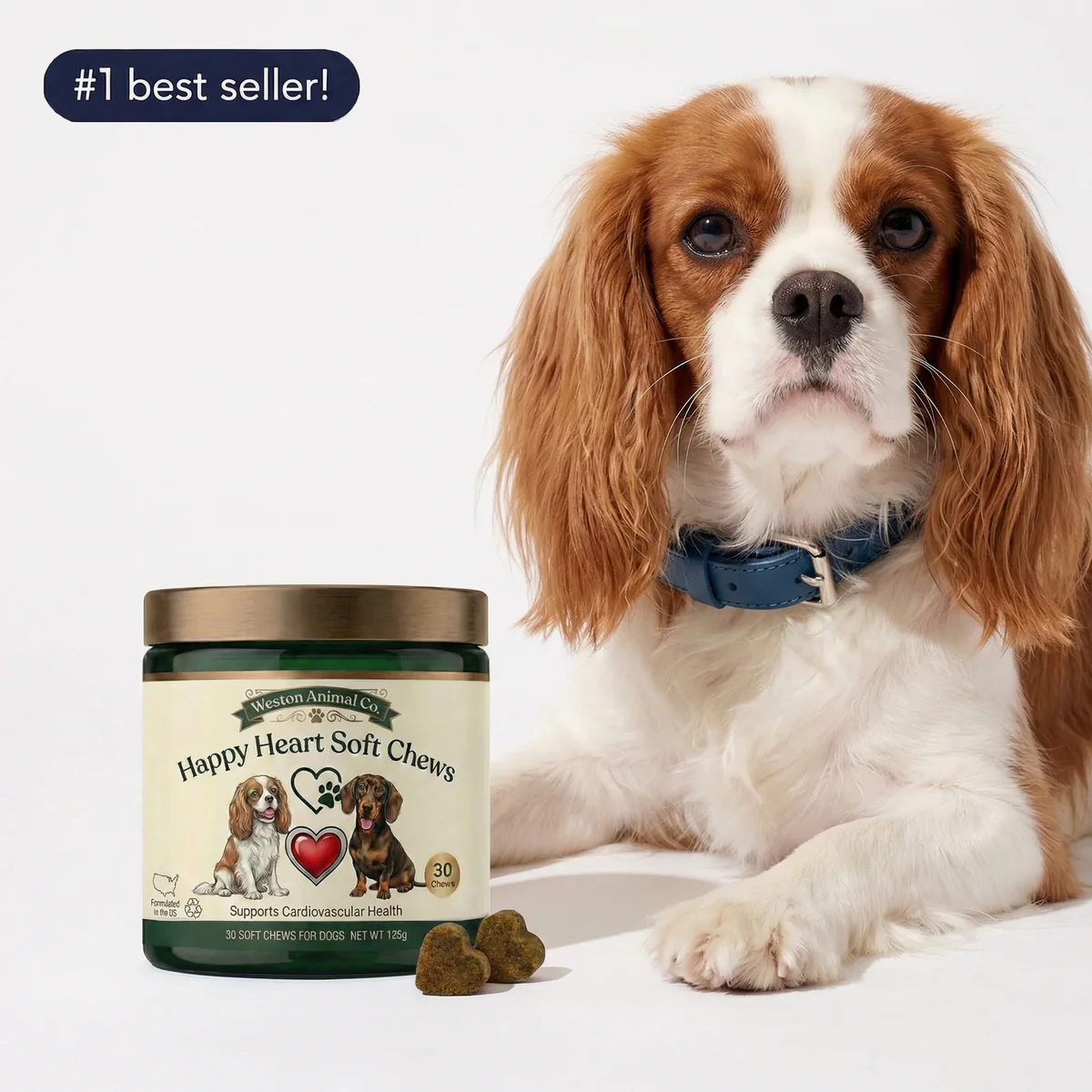
The one valve-specific formula I now point Cavalier owners to is Happy Heart Soft Chews by Weston Animal Co. I have no commercial relationship with them. I recommend it because the formula is built for mitral valve connective tissue rather than repackaged from a generic cardiac blend: ubiquinol CoQ10 (not ubiquinone), marine-source EPA/DHA, taurine at therapeutic dosing, standardized hawthorn extract, and every ingredient listed with exact milligram amounts. No proprietary blends. No fillers.
Editor’s Note
Happy Heart Soft Chews, Weston Animal Co.
- •Built for mitral valve connective tissue, not repackaged from a generic cardiac blend
- •Ubiquinol CoQ10 (the bioavailable form), not the cheaper ubiquinone
- •Marine-source EPA/DHA, taurine and standardized hawthorn at therapeutic doses
- •Dosed for Cavaliers (14–18 lb), not 70 lb retrievers
The three windows
There are really only three points where you can act, and they are not equal.
Before any murmur. The valve leaflets are still healthy. Connective-tissue support now is the simplest, cheapest, highest-leverage thing you will ever do for a Cavalier. This is the window most owners miss because nothing is “wrong yet.”
Stage B1 or B2. The murmur is detectable, the heart has not yet remodeled, and your cardiologist has not started medication. This is the “monitor” phase, the phase the standard protocol does almost nothing for. Filling the gap here is what determines how long stage C stays away.
Already on cardiac medication. The pump is being supported. The valve is not. Adding valve-targeted nutritional support does not replace anything your cardiologist has prescribed. It addresses the tissue the prescriptions were never designed to address.

If you own a Cavalier , puppy, adult, or senior, the window before the murmur is the only window you fully control. The second-best window is today.
View Offer →Frequently Asked Questions
My Cavalier has no murmur yet. Is this too early?
The opposite. In a breed where over 90% develop MVD, the pre-murmur window is the easiest and most leveraged time to support the connective tissue in the valve leaflets. By the time a murmur is audible, the tissue has been changing for months or years.
My dog is already on heart medication. Can I still give this?
Yes. Cardiac prescriptions support pump output; Happy Heart Soft Chews supports valve tissue. They work in different places and are designed to be used alongside your cardiologist’s plan. It is not a replacement for any prescribed medication.
Why not a generic heart chew from Amazon?
Most canine cardiac supplements are built around taurine and L-carnitine, which target dilated cardiomyopathy in breeds like Dobermans. Cavaliers face valve degeneration, which needs ubiquinol CoQ10, marine omega-3s and hawthorn. The wrong formula is the same as no formula.
How long until anything changes?
Connective tissue rebuilds slowly. Owners who track echo grades typically see the rate of progression flatten across the next two appointments rather than a dramatic change overnight. The point is not feeling better tomorrow, it is being at the same grade six months from now.
What if my dog refuses to eat it?
Weston Animal Co. backs every order with a 60-day money-back guarantee. If your dog turns up their nose, you get a full refund.
My dog is already Stage C. Is it too late?
No. We cannot undo remodeling already done, but supporting the remaining valve tissue with the right raw materials can still slow further progression at any stage. The best time to start was before the murmur. The second-best time is today.